Shenzhen, China – December 2025 – A leading global manufacturer of lithium-ion batteries and a top-tier solar panel producer have reported groundbreaking efficiency gains after integrating the ABB PFEA113-20 3BSE050092R20 tension control system into their production lines. As the demand for high-performance energy storage and renewable energy equipment surges, the PFEA113-20’s ±0.5% control accuracy and 10ms rapid response have become critical to solving the most pressing tension control challenges in precision manufacturing.
The Critical Need for Tension Control in New Energy Production
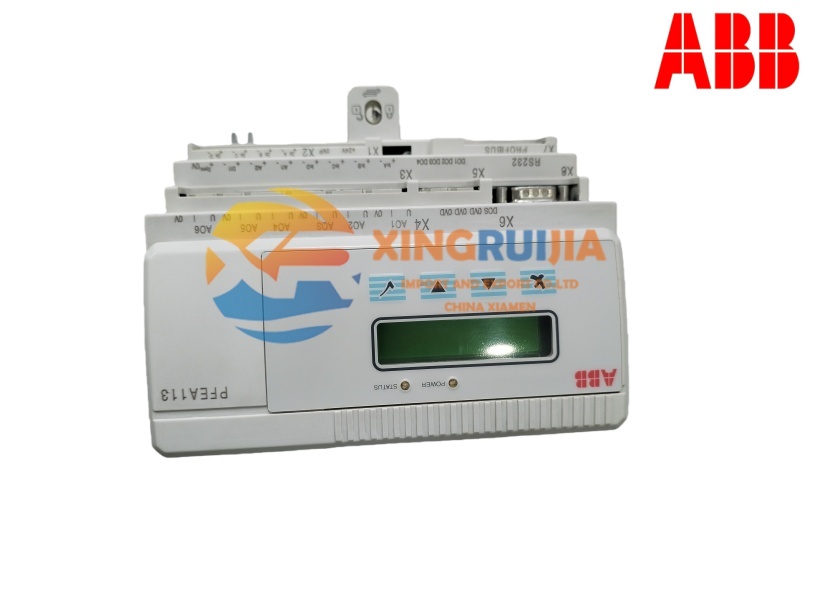
In lithium battery pole piece coating and solar wafer cutting, even the smallest tension fluctuations can lead to catastrophic product failures. For lithium battery manufacturers, copper foil and aluminum foil substrates as thin as 6-12μm require tension stability within ±0.3N—any deviation beyond this range causes wrinkles, tears, or uneven coating, directly impacting battery capacity consistency and safety. Similarly, solar wafer cutting relies on diamond wires operating at 30m/s; tension variations exceeding ±0.5μm result in uneven wafer thickness, reducing photovoltaic conversion efficiency by up to 15%.
“Our old tension controllers couldn’t keep up with the precision demands of our new high-speed coating lines,” said Wang Lei, Production Director at a Shenzhen-based 动力电池 (power battery) manufacturer. “We were seeing a 1.2% pole piece wrinkle rate and 0.8% breakage rate, which translated to millions in wasted materials annually.”
For solar wafer producers, the challenge was equally daunting. “Traditional controllers failed to adapt to rapid changes in wire speed and material properties,” explained Li Ming, Process Engineer at a Jiangsu-based solar technology firm. “Our wafer thickness tolerance was ±1.5μm, and we needed to narrow it to meet global quality standards.”
How ABB PFEA113-20 Solves New Energy’s Tension Control Pain Points
The ABB PFEA113-20 3BSE050092R20 tension controller addresses these challenges through three core technological advantages, tailored to new energy manufacturing needs:
1. Adaptive PID Algorithm for Dynamic Material Changes
The controller’s adaptive PID algorithm automatically adjusts gain parameters based on material properties (e.g., elastic modulus, thickness) and operating conditions (speed, acceleration). When switching between copper foil thicknesses (e.g., 6μm to 8μm) in battery production, the PFEA113-20 optimizes PID settings in 0.5 seconds, eliminating tension spikes that cause wrinkles. In solar wafer cutting, it adapts to diamond wire wear, maintaining consistent tension throughout the wire’s lifespan.
2. Taper Tension Control for Uniform Winding
For battery pole piece winding and solar wafer roll storage, the PFEA113-20 supports linear and S-type taper tension control. As the winding diameter increases from Φ100mm to Φ800mm, the controller linearly reduces tension, preventing the “inner tight, outer loose” issue that damages delicate materials. This feature alone reduced the solar firm’s wafer edge warpage rate by 40%.
3. Speed Compensation for High-Speed Production
With production line speeds exceeding 500m/min, the PFEA113-20’s speed compensation function adjusts tension in real time during acceleration/deceleration (up to 5m/s²). For battery coating lines, this means reducing tension by 10% during rapid starts to avoid material stretching, ensuring coating thickness tolerance within ±1μm.
Additionally, the controller’s compatibility with industrial communication protocols (Modbus RTU, Profibus-DP, EtherCAT) allows seamless integration with existing PLC systems (e.g., ABB 800xA, Siemens S7-1500), eliminating the need for full system overhauls. Its IP65 protection rating enables reliable operation in dusty, humid factory environments—a common issue in battery plants with solvent-based coating processes.
Measurable Results: New Energy Producers Reap Significant Gains
After 6 months of deployment, the Shenzhen battery manufacturer achieved remarkable improvements:
- Pole piece wrinkle rate dropped from 1.2% to 0.05%
- Material breakage reduced by 82%, saving 30 tons of copper/aluminum foil annually
- Production line speed increased by 18%, boosting daily output by 2,000 pole pieces
The Jiangsu solar firm similarly saw transformative outcomes:
- Wafer thickness tolerance narrowed from ±1.5μm to ±0.8μm
- Diamond wire breakage rate fell from 3 times per 10,000km to 0.5 times
- Photovoltaic conversion efficiency improved by 3.2% due to uniform wafer thickness
“ The ABB PFEA113-20 isn’t just a controller—it’s a quality guarantee,” Wang Lei emphasized. “We’ve been able to supply batteries to electric vehicle makers with zero quality complaints related to pole piece defects.”
Li Ming added, “The controller’s self-diagnostic features and remote monitoring capabilities have cut our maintenance time by 40%. We can troubleshoot issues without stopping production.”
Future Outlook: Expanding to Next-Gen Energy Production
Both manufacturers plan to expand the deployment of ABB PFEA113-20 controllers to their new plants in Europe and Southeast Asia. ABB’s global product manager for tension control, Anna Schmidt, noted, “The PFEA113-20 is engineered for the evolving needs of new energy manufacturing—where precision, speed, and reliability directly impact sustainability goals. Its modular design allows for easy scaling as production lines grow.”
As the global transition to renewable energy accelerates, the ABB PFEA113-20 3BSE050092R20 tension controller is poised to become an indispensable tool for manufacturers seeking to optimize quality, reduce waste, and enhance production efficiency.